
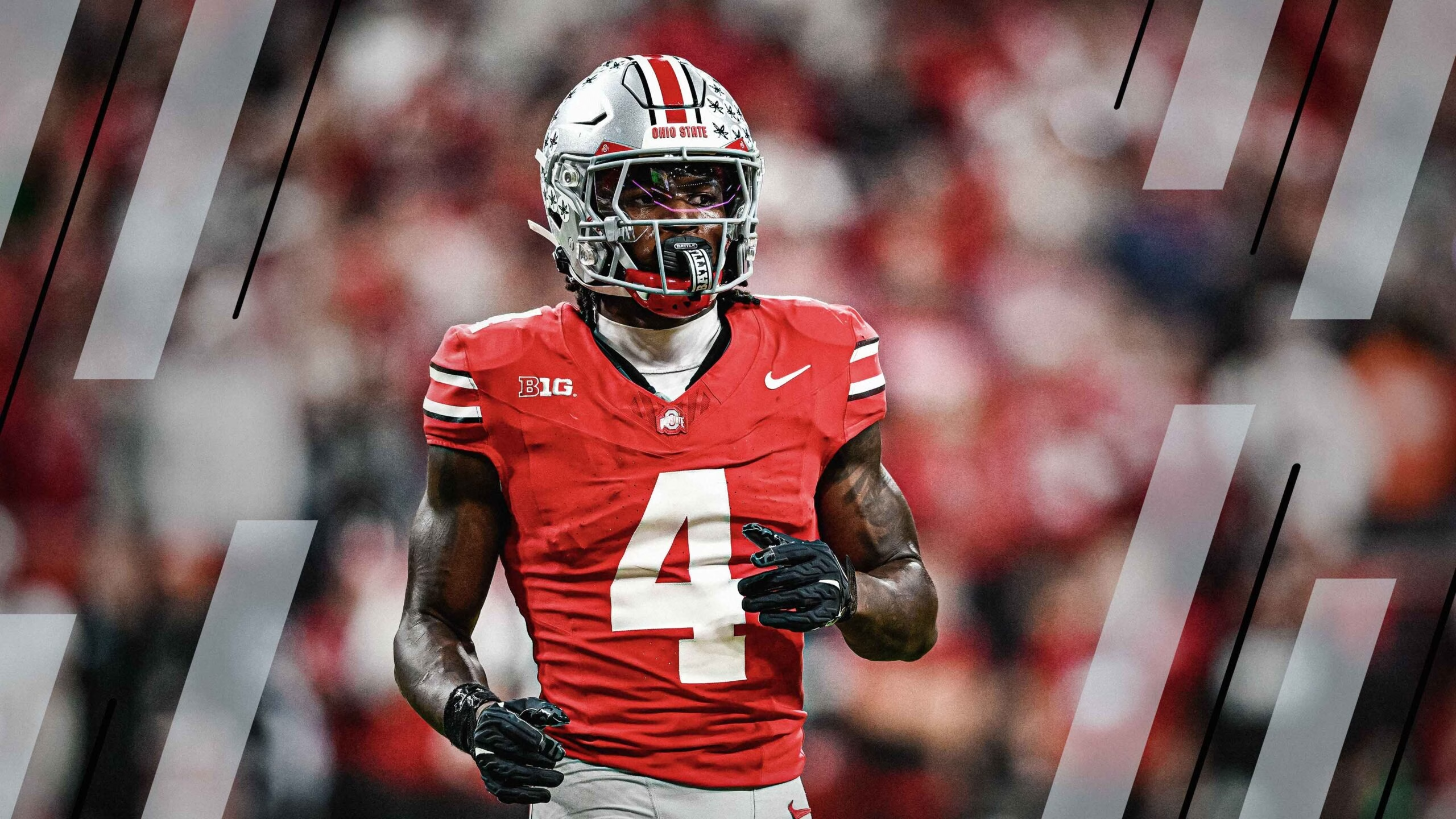
The 2027 rookie class might be special.
Seriously.
Jeremiah Smith already looks like the kind of prospect dynasty managers will spend two years dreaming about. There are quarterbacks with legitimate NFL upside. More high-end skill players will emerge. By the time rookie drafts actually arrive, there is a real chance 2027 becomes one of the most anticipated classes we have seen in years.
But something weird is already happening.
Dynasty managers are starting to treat any 2027 first like it comes with Jeremiah Smith attached.
It does not.
And that is where people are going to get themselves into trouble.
Because there are two very easy ways to mishandle 2027 picks:
You can trade them away like your future is guaranteed.
Or you can hoard them like every one is a future superstar.
Both are mistakes.
The real question is not whether 2027 picks are good assets.
They are.
The real question is whether dynasty managers have started paying for the dream before they know what they are actually buying.
The 2027 Hype Is Real
Let’s get this out of the way first.
This is not an article arguing that the 2027 class is overrated.
The excitement makes sense.
Jeremiah Smith is the obvious headliner, but the conversation goes much deeper than one receiver. Names like Arch Manning, Dante Moore, Julian Sayin, Bryce Underwood, Savion Hiter, and Chris Henry Jr. are already part of early 2027 discussions.
Some of those players will rise.
Some will fall.
A few prospects currently being treated like future stars will never get close.
That happens every year.
But there is enough high-end talent on the radar that the hype is not coming from nowhere.
The problem starts when managers hear “great class” and mentally turn every future first into a premium pick.
That is not how it works.
A 2027 First Is Not Just a 2027 First
This is probably the biggest mistake dynasty managers make with future picks.
Someone says:
“I got a 2027 first.”
My first question is always:
Whose first?
Because that matters a lot more than people pretend.
A 2027 first from an aging contender with no quarterback depth could become one of the best assets in your league.
A 2027 first from a young superteam with elite quarterbacks, strong depth, and extra future picks might have a pretty narrow path to becoming anything better than late.
Yet we constantly flatten both into the same thing:
2027 1st
That is convenient for calculators.
It is not reality.
Think about the difference.
2027 First From a Fragile Roster
Possible outcome: 1.10
Likely range: 1.04–1.07
Real upside: 1.01
2027 First From a Young Powerhouse
Possible outcome: 1.12
Likely range: 1.09–1.12
Real upside: maybe 1.06
Those are not the same asset.
They should not cost the same.
And if your league treats them the same, that is an edge you should be attacking.
The Scariest Pick to Trade Is Usually Your Own
This is where dynasty managers can really hurt themselves.
It is the offseason.
Your roster looks good.
You finished near the top of the league last year. Your projections are strong. You have a few stars. Maybe a rankings tool tells you that you are the second-best team in the league.
Then someone offers you a useful veteran for your 2027 first.
You tell yourself:
“It’ll probably be late.”
Maybe.
But that is not what you are actually trading.
You are trading every possible version of what happens between now and then.
The version where your quarterback gets hurt.
The version where your aging running back finally falls off.
The version where your breakout candidate does not break out.
The version where two starters miss six weeks.
The version where your team scores plenty of points but gets crushed by schedule luck.
The version where you miss the playoffs by one game.
Suddenly, that “obvious late first” is 1.05.
Or 1.03.
And someone else owns it.
That is why I view my own future first differently from almost every other pick.
Your own first is not just draft capital.
It is insurance against being wrong about your own team.
And dynasty managers are wrong about their teams all the time.
Future Firsts Buy You Time
This is the easiest way I know to think about a future pick.
A player is one specific bet.
A future first lets you wait.
A player can tear an ACL.
Lose his job.
Get replaced in the draft.
Change teams.
Hit an age cliff.
Disappear from an offense.
A future pick does not score points for you today, which is obviously the downside.
But it also is not tied to one player.
Every month you hold it, you learn more.
You learn which college players actually broke out.
Which quarterbacks the NFL likes.
Which running backs received real draft capital.
Which landing spots opened up.
Which dynasty teams in your league are falling apart.
And most importantly, where the pick itself is actually likely to land.
That flexibility has value.
It is why I hate the argument that future picks are just “dead points sitting on your bench.”
That misses the entire reason people want them.
You are buying time and options.
The Opposite Mistake Is Paying for Jeremiah Smith When You Are Buying the 1.11
This is where the hype gets dangerous.
A manager watches Jeremiah Smith.
Reads about the class.
Sees people calling 2027 loaded.
Then a random 2027 first becomes available.
And somewhere in their head, that pick starts looking like access to the top of the class.
It probably is not.
You might be buying the 1.11.
That is the trap.
The best prospects create excitement around every pick in the class, even when a specific pick has very little chance of landing near them.
I think of this as the Jeremiah Smith Tax.
You are paying for the idea of the class instead of the actual odds attached to the pick.
That does not mean a late 2027 first is bad.
A strong class makes late picks more interesting too.
But there is still a price where the asset becomes a bad buy.
A great rookie class does not make every trade for a 2027 first a good trade.
Stop Asking Whether 2027 Firsts Are Buys or Sells
I keep seeing the same question:
“Are you buying or selling 2027 firsts?”
That is way too broad.
The real question is:
Which 2027 first? From which manager? At what price? And for what kind of roster?
Say you are moving the same productive 27-year-old wide receiver in two different deals.
Offer A
You receive a 2027 first from a roster with:
- aging starters
- weak quarterback depth
- limited future picks
- very little bench insulation
Offer B
You receive a 2027 first from a roster with:
- young elite quarterbacks
- strong depth
- extra future picks
- one of the best starting lineups in the league
A calculator may call both assets:
2027 1st
I would not value them remotely the same.
The first one gives you real upside if the roster cracks.
The second one probably requires a lot to go wrong before it becomes an early pick.
This is where knowing your league should beat blindly following market value.
Every Dynasty Team Has Two Clocks
I think this is where a lot of pick strategy gets messed up.
Your team is always dealing with two different timelines.
Your Roster Clock
Your players are aging.
Your championship window can open and close quickly.
A 2027 pick cannot help you win a 2026 semifinal.
Sometimes you need points now.
Your Pick Clock
Future picks become easier to understand as time passes.
The rookie class gets clearer.
The NFL Draft happens.
Landing spots arrive.
Your league standings start telling you which teams are actually good and which ones only looked good in July.
The mistake is paying attention to only one clock.
A rebuilder who keeps trading future picks for aging veterans is ignoring the future.
A contender who refuses to move any picks while sitting on a real championship window is ignoring the present.
The goal is not to collect the most picks.
The goal is to use them when they are most valuable to your team.
What Rebuilders Should Do
If you are rebuilding, yes, you should probably want 2027 capital.
But I would not just chase any first I can get.
I want picks from teams that look stronger than they actually are.
Give me the roster with:
- aging running backs
- older stars carrying weak depth
- questionable quarterbacks in Superflex
- very few future picks
- too much value concentrated in three or four players
- no real bench
- a manager who constantly trades away depth
Those are the picks I want.
The perfect future first is not simply attached to a bad team.
Bad-team managers usually know their picks are valuable.
The better target is often the team everyone thinks is safe.
The contender that is one injury away from falling apart.
The roster that looks great in a starting lineup screenshot but has nothing behind it.
That is where the upside lives.
And if you are rebuilding, I would be extremely careful with your own 2027 first.
If your rebuild takes longer than expected, your pick gets better.
That is exactly the protection you want.
What Contenders Should Do
Contenders should absolutely trade future picks.
I have never understood the idea that good dynasty management means refusing to move firsts.
The entire point is to win.
But there is a huge difference between:
“This trade meaningfully improves my chances of winning the league.”
and:
“I wanted another decent starter.”
If I am moving a 2027 first, I want something that matters.
A real lineup difference-maker.
A player who fixes a major weakness.
A legitimate positional edge.
Someone who gives me protection after an injury.
A move that changes my playoff path.
What I do not want to do is casually trade my own future first in July because I think I am a contender.
By the trade deadline, I will know much more.
I will know my record.
My points.
My injuries.
Which other teams are real threats.
Whether I actually need help.
Sometimes paying a little more later is better than selling all that uncertainty too early.
Middling Teams Are in the Most Danger
This is the group I worry about most.
The sixth-best team in a 12-team league.
Not terrible.
Not a real favorite.
Just good enough to talk itself into anything.
These teams constantly make the same mistake.
They trade a future first for a modest veteran upgrade.
They keep older players because “anything can happen.”
They refuse to rebuild because they might sneak into the playoffs.
Then they finish 7-7, lose in the first round, and enter the offseason with:
- an older roster
- no championship
- no future first
- fewer ways to improve
That is how dynasty teams slowly die.
If you are in the middle, your own 2027 first should be very difficult to move before the season gives you more information.
Keep the escape hatch.
You can always get aggressive later.
You cannot undo the trade after your roster collapses and someone else owns the 1.03.
What I Would Actually Do With 2027 Firsts
Here is my approach right now.
1. Treat Your Own First Differently
Your own first protects you if your roster is worse than you think.
That makes it different from every other future pick you own.
I would not treat it like generic trade inventory.
2. Look at the Team Behind the Pick
Do not stop at early, mid, or late.
Look at:
- quarterback stability
- starter age
- bench depth
- injury risk
- future picks
- positional balance
- manager tendencies
- how much value is concentrated in a few players
Some of the best future picks to buy are attached to teams that currently look good.
3. Do Not Pay the Hype Price Blindly
Whenever someone says:
“But the 2027 class is loaded.”
Ask:
Where is this pick actually likely to land?
The class matters.
The pick number still matters too.
4. Do Not Trade Your Own First for Depth
This is probably my strongest rule.
There are too many ways to find usable depth without moving an unprotected future first.
Waivers.
Cheaper veterans.
Smaller pick packages.
In-season trades.
Injury replacements.
I am not risking a future top-five pick just to make my bench look nicer.
5. Buy Picks From Teams With Hidden Downside
Do not just ask which teams are bad.
Ask which apparently good teams have the most ways to become bad.
That is a much more interesting question.
An aging contender with no depth can be a better pick target than an obvious rebuilding team.
6. Be Willing to Sell Into the Hype
This is the part people do not like hearing.
If your league starts pricing every 2027 first like it has a realistic shot at the top three, I would sell some of them.
Not all.
Not automatically.
But dynasty is still a market.
If someone is willing to massively overpay because they are dreaming about Jeremiah Smith, let them.
A great class does not make a bad price good.
The Bottom Line
The biggest mistake with 2027 picks is not buying them.
It is not selling them.
It is failing to understand what you actually own.
A 2027 first can be championship ammunition.
Rebuild insurance.
A bet against an aging roster.
A liquid asset you hold until more information arrives.
A real path to an elite prospect.
Or an overpriced mystery box.
Sometimes it is several of those things at once.
That is why “2027 picks are amazing” is not a strategy.
And “picks do not score points” is not a strategy either.
The class might be incredible.
Jeremiah Smith might become exactly the kind of dynasty asset everyone thinks he can be.
But you do not win leagues just by knowing great prospects are great.
You win by understanding when the market has started pricing a dream that the actual pick may never give you access to.
The class can be special.
The pick can be valuable.
And the trade can still be terrible.
That is the 2027 pick trap.