
Every dynasty manager has a player like this.
A former rookie pick sitting at the bottom of the roster. The flashes were minimal. The production never came. But every offseason, you talk yourself into one more year.
Maybe the coach changes.
Maybe the depth chart opens up.
Maybe the talent finally wins out.
Sometimes it happens.
Usually it doesn’t.
And that’s one of the hardest lessons in dynasty: knowing when patience becomes a roster leak.
The StatChasers Rookie Hit Rate Tool tracked 410 dynasty rookies from 2017–2023 in SF/PPR formats to answer one specific question:
If a player still hasn’t produced by a certain point in his career… what are the odds he ever will?
The results are a lot harsher than most dynasty managers want to believe.
| Position | Odds After Year 1 Miss | Odds After Year 2 Miss | Odds After Year 3 Miss |
|---|---|---|---|
| QB | 25.5% | 8.6% | 7.5% |
| RB | 18.0% | 8.1% | 2.1% |
| TE | 28.9% | 17.1% | 6.6% |
| WR | 19.2% | 12.0% | 4.5% |
The above table shows odds a rookie pick will finish top-24 for their position in a 5-round 12-team dynasty draft if they did not year 1. These aren’t projections.
This is what actually happened historically to players who failed to reach top-24 fantasy production by those checkpoints in their careers.
And once you see the numbers, it becomes obvious why some dynasty rosters stay permanently stuck in the middle.
Running Backs: Dynasty’s Fastest Expiration Date
No position loses value faster than running back.
And the data absolutely reflects it.
A running back who fails to produce through his first two NFL seasons has just an 8.1% chance of eventually becoming a top-24 fantasy RB at some point of his career.
After Year 3?
2.1%.
At that point, you’re not holding upside anymore. You’re holding a name.
This is where dynasty managers get trapped by rookie draft capital. They remember where the player was selected, what the prospect profile looked like, or the hype cycle from two offseasons ago.
Meanwhile, the NFL has already moved on.
Running backs have the shortest runway in fantasy football. If they haven’t carved out meaningful touches early, there’s usually a reason:
- another RB beat them out
- the coaching staff doesn’t trust them
- they can’t pass protect
- they’re inefficient
- the team already replaced them
Late-breakout RBs do exist. They’re just extremely rare.
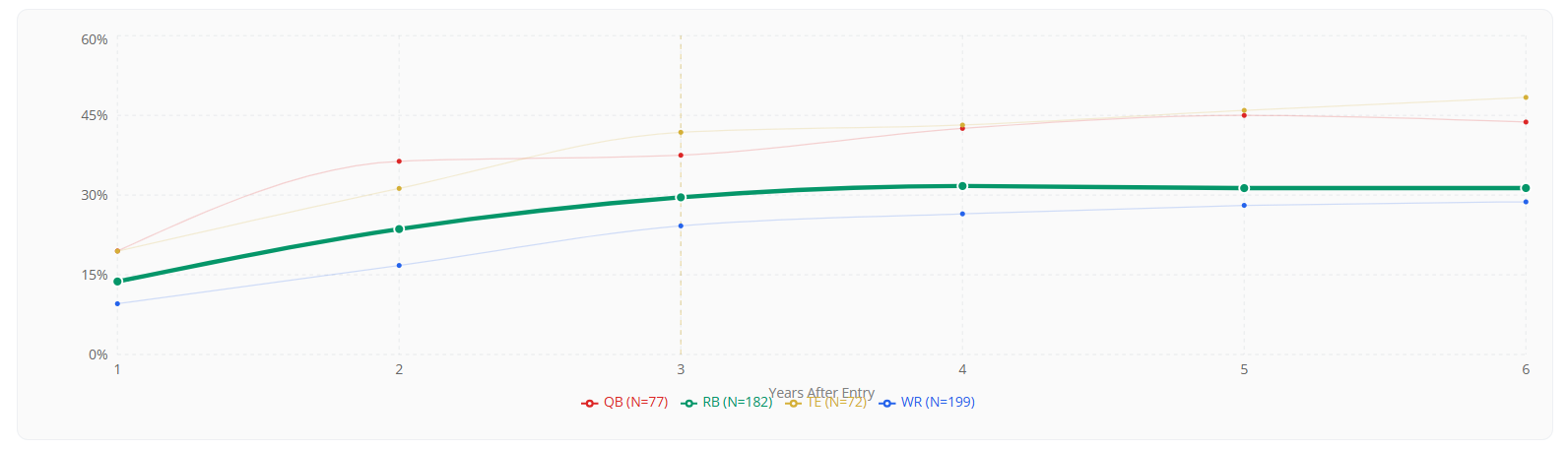
The important dynasty takeaway here isn’t just “sell bad RBs.”
It’s understanding when to sell them.
The Year 2 offseason is usually your last real leverage window.
At that point, managers still believe in the draft profile. They still remember the prospect hype. Once Year 3 passes without production, that insulation disappears almost entirely.
That’s when players go from “post-hype sleeper” to waiver-wire clogger.
Wide Receivers Get More Patience, But Not Infinite Patience
Wide receiver development is slower.
Dynasty players know that, which is why WRs typically get a longer leash than RBs.
And to be fair, the data supports some patience.
A WR who misses in Year 1 still has a 19.2% chance of eventually becoming a top-24 producer. After Year 2, the odds fall to 12%.
That’s still meaningful.
But after Year 3?
4.5%.
At that point, you’re basically betting on outlier outcomes.
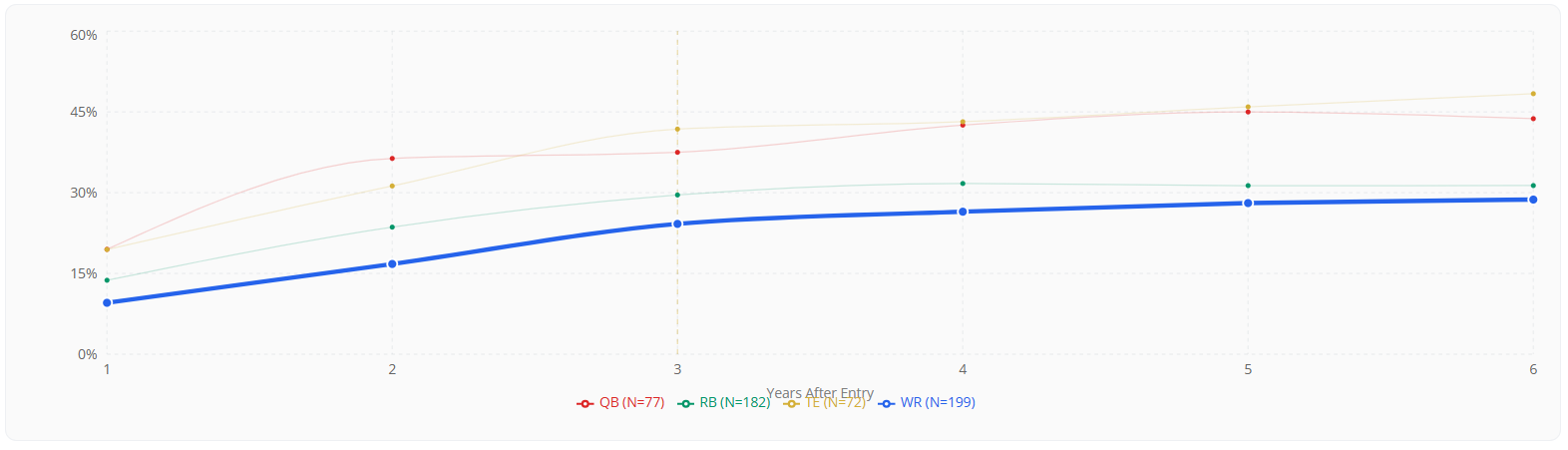
This is where dynasty managers often confuse “possible” with “probable.”
Yes, receivers can develop later than RBs.
Yes, situations can change.
Yes, talent sometimes takes time.
But true breakout WRs usually show signs before Year 4.
Even the slower-developing success stories were typically flashing efficiency, earning targets, or climbing roles well before then.
A receiver who remains invisible through three full seasons usually isn’t “waiting for opportunity.”
More often, he’s just not that guy.
For WRs, Year 3 is the real decision point.
That’s your final meaningful sell window before the market fully adjusts.
Tight Ends Actually Deserve Patience
This is the one position where dynasty managers are often not patient enough.
Tight ends showed the strongest long-term survival odds in the entire dataset.
Even after missing through Year 2, TEs still had a 17.1% chance of eventually becoming top-24 fantasy options for their position.
That’s more than double the RB number at the same stage.
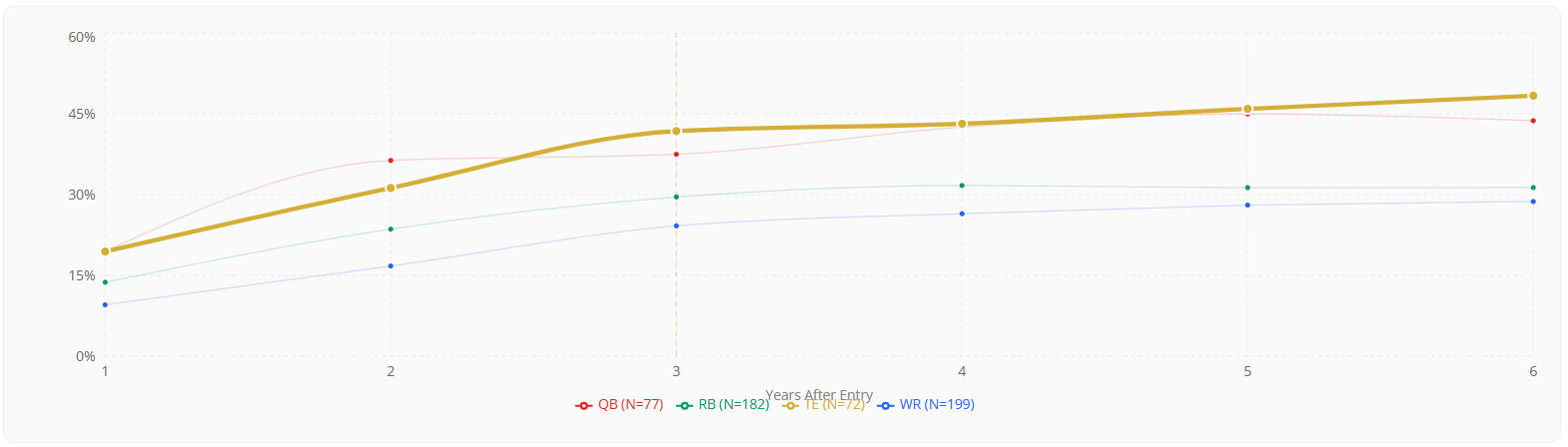
And honestly, it makes sense.
TE is just different.
Young tight ends have to:
- learn blocking assignments
- earn coaching trust
- handle NFL physicality
- develop route-running nuance
- compete with veteran TEs already entrenched in offenses
A lot of rookie TEs simply aren’t asked to be fantasy-relevant immediately.
That’s why dynasty managers constantly get burned trying to apply RB timelines to tight ends.
The real cliff for TE comes later.
The drop from Year 2 (17.1%) to Year 3 (6.6%) is massive. That’s when the “developmental TE” narrative usually runs out of runway.
But through Year 2? Patience is often justified.
A quiet Year 1 TE isn’t necessarily a roster problem.
It may actually be a buying opportunity.
Quarterbacks Have the Harshest Early Cliff
Quarterback is fascinating because the timeline is extremely front-loaded.r
After missing in Year 1, QBs still retained a 25.5% chance of eventually hitting.
But after Year 2?
That number collapses to 8.6%.
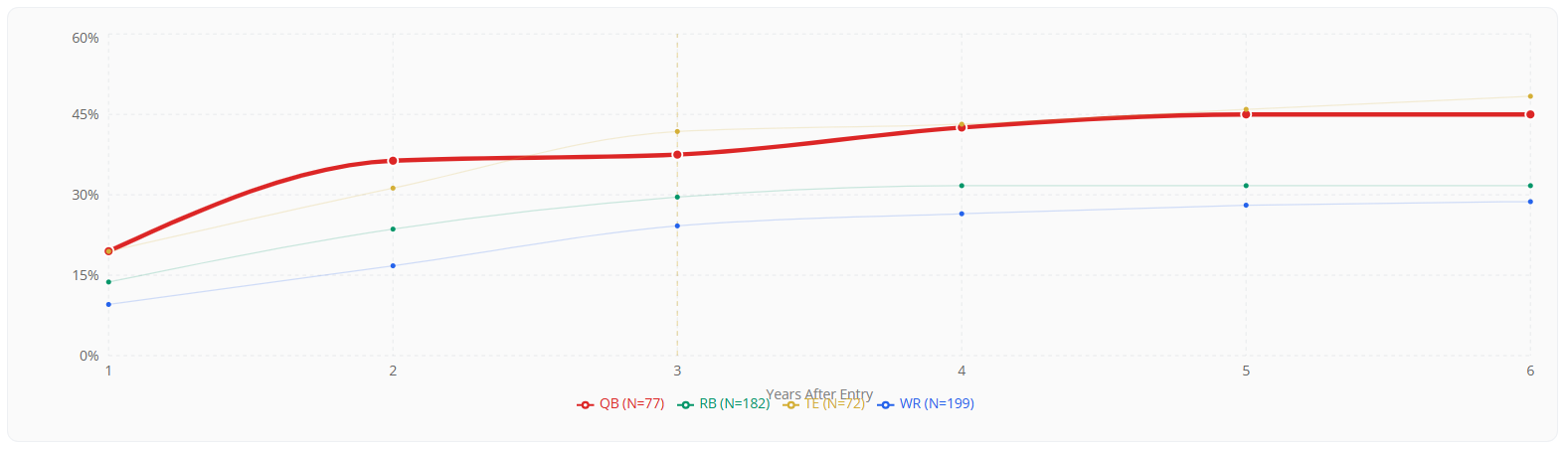
That drop tells you almost everything you need to know about how NFL teams treat quarterbacks.
If a QB isn’t showing a legitimate path toward starting relevance by Year 2, organizations usually already know what they have.
Either:
- the player isn’t progressing
- the coaching staff doesn’t trust him
- or the team is already looking for the next option
That’s why Superflex dynasty values can collapse so violently.
The interesting part is what happens after that.
Unlike RBs, QB odds don’t completely crater after Year 2. The decline from 8.6% to 7.5% is actually fairly small.
Why?
Because the rare late-career QB resurgence does exist.
Backup quarterbacks occasionally survive long enough to land the right opportunity years later. It’s uncommon, but common enough that the probability never fully dies.
Still, the main dynasty takeaway is pretty clear:
If your young QB still doesn’t have a believable starting path by Year 2, the market is usually overvaluing him relative to the actual odds.
The Most Important Dynasty Inflection Point Is Year 2
When you zoom out from individual positions, one trend dominates the entire dataset.
The biggest cliff happens between Year 1 and Year 2.
Not Year 3.
Not Year 4.
Year 2.
That’s the point where:
- the NFL has gathered meaningful information
- coaching staffs have made decisions
- depth charts settle
- replacement players arrive
- and fantasy managers start realizing which bets are failing
It’s also the last point where many struggling players still retain market value tied to draft capital and perceived upside.
That’s why strong dynasty managers are often willing to move on earlier than the rest of the league.
Not because they’re impatient.
Because they understand opportunity cost.
Every dead roster spot delays your ability to cycle into the next breakout.
Applying This Right Now to Your Dynasty Roster
2024 RBs who disappointed as rookies?
You probably have one more offseason before the market fully turns on them.
The odds aren’t dead yet, but the clock is moving quickly.
2025 WRs who underwhelmed?
Still reasonable holds.
Year 2 is the real evaluation window for most receivers.
2025 TEs who did nothing?
Hold them.
Seriously.
This is the one position where dynasty players consistently underestimate the development timeline.
2025 QBs without a path to starting?
This is the uncomfortable one.
The historical drop-off after Year 1 is brutal. If the market still values the pedigree, you should at least explore moving them before Year 2 destroys that insulation.
2024 players entering Year 3 with nothing?
This is where dynasty players have to stop lying to themselves.
Across almost every position, the odds are now in the low single digits.
The market still remembers the name.
The NFL usually doesn’t.
The Bottom Line
Dynasty leagues are won by managers who know when to move on.
Holding every struggling rookie forever feels patient. In reality, it’s often just avoiding admitting a bad bet.
The best dynasty players don’t just identify breakout candidates well.
They recycle roster spots aggressively.
They understand opportunity cost.
And they recognize when the odds have already shifted against them.
Because in dynasty, one of the biggest edges isn’t identifying stars.
It’s avoiding multi-year attachment to players who probably never were.
Analysis based on SF/PPR dynasty formats using 2017–2023 rookie classes with minimum three-year evaluation windows via the StatChasers Rookie Hit Rate Tool cohort survival model.