Landing the 1.01 in a fantasy football draft is a gift, but it also comes with one obvious challenge.
You get any player you want. Then you wait.
In a 12-team league, that long gap between Pick 1 and Pick 24 can change the entire board. Running backs can dry up. Wide receiver tiers can collapse. Quarterbacks can get pushed down. Tight ends can either go too early or sit longer than expected.
That is why drafting from the first overall spot is not just about getting the best player in Round 1. It is about understanding how to use the turn.
When you pick first, you control the first name off the board. After that, your biggest advantage is the ability to make back-to-back picks and shape your roster in pairs. You can start a positional run, stop a tier from getting away, or balance your roster before the board swings back around.
In a 12-team Sleeper PPR league with 1 QB, 2 RB, 2 WR, 1 TE, 2 FLEX, the best 1.01 build should usually focus on three things: locking in elite touches, attacking target volume, and waiting on the positions that are easier to replace later.
That means no panic picks just to fill a lineup spot.
Start with a true difference-maker, then use the turns to build value.
The 1.01 Strategy
The first overall pick gives you access to the entire player pool, so the goal is simple: do not get cute.
Take a player with elite workload, elite efficiency, and a path to week-winning production. In PPR, that usually means a running back who catches passes or a wide receiver with massive target volume.
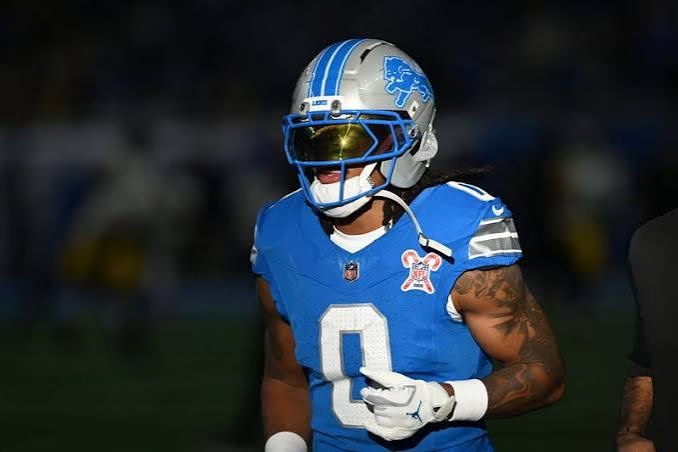
For this build, the ideal start is Jahmyr Gibbs.
Gibbs has already proven he can be one of the most valuable fantasy players in football. He averaged 21.7 PPR points per game in 2025, scored heavily over the last two seasons, and set a career high with 4.5 receptions per game. With David Montgomery no longer in Detroit, the path to even more work is sitting right in front of him.
That is exactly what we want from the 1.01.
You are not just drafting talent. You are drafting elite access to fantasy points.
Gibbs gives you rushing efficiency, receiving usage, touchdown upside, and one of the cleanest weekly ceiling profiles in the league.
Bijan Robinson, Ja’Marr Chase, and Puka Nacua are all reasonable alternatives. But if the goal is to open with a player who can anchor the entire roster, Gibbs checks every box.
Round 1: Jahmyr Gibbs
Starting with Gibbs gives this roster a true RB1 and immediately creates flexibility at the 2/3 turn.
That matters because the next pick does not come until 24 overall. If you start with a wide receiver, you may feel pressured to take a running back at the turn. If you start with Gibbs, you can let the board come to you.
That is the hidden value of the 1.01.
You do not need to force a build right away. You can secure the elite running back, then see whether the room gives you RB value, WR value, or a combination of both.
In this draft, the best version of the turn is Chase Brown plus DeVonta Smith.
Rounds 2–3: Chase Brown and DeVonta Smith
Chase Brown is the preferred pick at the 2/3 turn if he is available.
He gives this roster a second running back with real workload upside. Over the last two seasons, Brown has handled a major share of Cincinnati’s rushing work while also adding receiving usage. He has drawn 4.6 targets per game in that span and scored 22 total touchdowns.
That is the kind of profile that fits perfectly next to Jahmyr Gibbs.
The Bengals may talk about wanting to involve other backs, but until that consistently shows up on the field, Brown remains the player to target.
If Brown is gone, Jeremiyah Love or Chris Olave are strong fallback options. Love keeps the early-RB build alive with upside at a scarce position, while Olave gives you a safer target-volume profile in PPR.
Then comes DeVonta Smith.
Smith is one of the best values in this range because his target ceiling has changed. With A.J. Brown traded to New England, the Eagles have a massive number of vacated wide receiver targets. Smith has already shown he can command volume when Brown is not on the field, and now he enters 2026 as the clear top option in Philadelphia’s passing game.
Through three rounds, the ideal build is Gibbs, Brown, and Smith. But if Brown does not make it back, Love or Olave are the cleanest pivots.
Rounds 4–5: Jaylen Waddle and Ladd McConkey
The 4/5 turn is where this build starts to separate.
After starting RB-RB-WR, the priority becomes wide receiver volume. In PPR leagues, you do not want to leave the early-middle rounds without multiple receivers who can command targets.
Jaylen Waddle fits that perfectly.
Waddle now lands in Denver after a major offseason trade, giving the Broncos a needed playmaker in a passing game that still had room to grow. Even in a disappointing Miami offense in 2025, Waddle still finished as a useful PPR receiver. He has been one of the most productive wideouts in football since entering the league, and now he gets a fresh situation where his speed and route-running can immediately become central to the offense.
As a WR2 or WR3 on this build, Waddle is exactly the kind of upside bet worth taking.
Then comes Ladd McConkey.
McConkey disappointed in 2025 after a strong rookie season, but the 2026 setup is much better. Keenan Allen is no longer blocking the top target role, and Mike McDaniel is now calling the offense in Los Angeles.
That is a major change.
McConkey’s rookie year showed what he can be when the Chargers use him as a featured weapon. He averaged 15.1 PPR points per game in 2024 before falling to 11.3 in 2025. If McDaniel creates a more efficient passing structure for Justin Herbert, McConkey has a real chance to bounce back in a big way.
This is the kind of pick that can look obvious later.
At this point, the roster has Gibbs, Brown, Smith, Waddle, and McConkey. That is a strong start: two backs with valuable touches and three receivers with real target paths.
Rounds 6–7: Tucker Kraft and DJ Moore
By Round 6, Tucker Kraft is worth attacking if he is still available.
Mid-round tight ends can be risky, but Kraft offers a real ceiling. Before injury cut his 2025 season short, he was producing like one of the better tight ends in fantasy football. He finished as the TE2 in PPR points per game and had four top-12 weeks in his first seven games.
If Kraft is healthy, he gives this roster access to difference-making tight end production without paying an early-round price.
Then comes DJ Moore.
Moore is exactly the type of receiver worth taking in this range. He has already shown he can command targets, produce through imperfect offensive situations, and deliver useful fantasy weeks even when the environment is not ideal.
As your WR4 or flex option, Moore gives this build another proven receiver with volume upside. After starting with Jahmyr Gibbs, Chase Brown, DeVonta Smith, Jaylen Waddle, and Ladd McConkey, adding Moore gives the roster a strong PPR foundation and more weekly flexibility.
Through seven rounds, the build has two high-touch running backs, four receivers with target upside, and a tight end with top-five potential.
That is a strong start from the 1.01.
Rounds 8–9: Chris Godwin and Justin Herbert
Round 8 is where Chris Godwin becomes one of the better values on the board.
His 2025 season was not great. He posted a career-low 3.7 receptions per game and did not look like the same weekly fantasy asset managers were used to seeing. But the underlying case is still interesting.
Tampa Bay has vacated wide receiver targets, and Godwin still showed he can create after the catch. He averaged 6.2 yards after the catch per reception in 2025, one of the better marks among qualified wide receivers.
At this price, you are not drafting Godwin to be your WR1 or WR2.
You are drafting him as a bench receiver or flex option who still has a path to more volume than the market is pricing in.
That is a good bet.
Then comes Justin Herbert in Round 9.
This is the right time to attack quarterback in a one-QB league. Herbert gives you the upside of a major offensive rebound without forcing you to spend early draft capital at the position. He also pairs naturally with McConkey, creating a skinny stack inside a Chargers offense that could look much different under McDaniel.
Herbert also adds rushing value. He was second among quarterbacks in rushing yards last season with 498, which gives him more fantasy paths than people sometimes realize.
In one-QB formats, this is the ideal quarterback bet: wait, then take a player with top-tier talent, improved play-calling, and a stack already on your roster.
Full Draft Build
This draft comes together cleanly because the early picks create balance without forcing it.
The core looks like this:
QB: Justin Herbert
RB: Jahmyr Gibbs
RB: Chase Brown
WR: DeVonta Smith
WR: Jaylen Waddle
TE: Tucker Kraft
Flex: Ladd McConkey
Flex: DJ Moore
Bench/Flex: Chris Godwin
The strength of this roster is not just the starting lineup. It is the number of players with realistic paths to beating ADP.
Gibbs can be the overall RB1. Brown can stay locked into valuable touches in Cincinnati. Smith can become the clear top target in Philadelphia. Waddle gets a fresh start in Denver. McConkey could be the biggest winner from the Chargers’ coordinator change. Kraft has top-five tight end upside if healthy. Herbert can jump back into the high-end QB1 conversation.
That is what you want from the 1.01. Not just names. Paths to value.
Late-Round Strategy
The late rounds should be simple: Use your bench spots on players who can gain value.
That means backup running backs with contingent upside, receivers with target paths, and tight ends who can become weekly starters if the role breaks right.
Isaiah Likely is a strong late-round tight end target if he falls. He gives you athletic upside, spike-week potential, and a path to matter if his role expands.
At running back, target valuable backups and handcuffs who could become immediate fantasy starters if the depth chart changes. Jordan Mason, Chris Rodriguez, and Keaton Mitchell are the types of late-round backs worth targeting because one injury or role shift could make them much more valuable.
You can find the full StatChasers RB handcuff list here: https://statchasers.com/rb-handcuff-rankings/
Players like Stefon Diggs, Chigoziem Okonkwo, AJ Barner, Trevor Lawrence, and Bo Nix are also worth watching depending on how deep the draft goes and how your league values bench upside.
The goal is not to fill your bench with safe names. The goal is to draft players who can become more valuable after the draft. Your bench should be built for upside, not decoration.
Final Verdict
Drafting first overall in a 12-team Sleeper PPR league gives you a major advantage, but only if you use the turn correctly.
The mistake is thinking the draft is over once you take the best player at 1.01.
It is not.
The 1.01 gives you the anchor. The turn picks build the team.
This build starts with Jahmyr Gibbs, then adds Chase Brown and DeVonta Smith at the 2/3 turn. From there, it attacks wide receiver value with Jaylen Waddle and Ladd McConkey, adds tight end upside with Tucker Kraft, grabs PPR-friendly depth with DJ Moore and Chris Godwin, and finishes with Justin Herbert at quarterback.
That is the kind of roster that can win in PPR.
It has elite RB production. It has wide receiver volume. It has a tight end with weekly ceiling. It has a quarterback tied to an improved offensive setup. And it does not waste early capital on kicker or defense.
The 1.01 is a gift.
But the edge is not just taking the best player first.
The edge is building the rest of the roster correctly after everyone else has to wait for you.