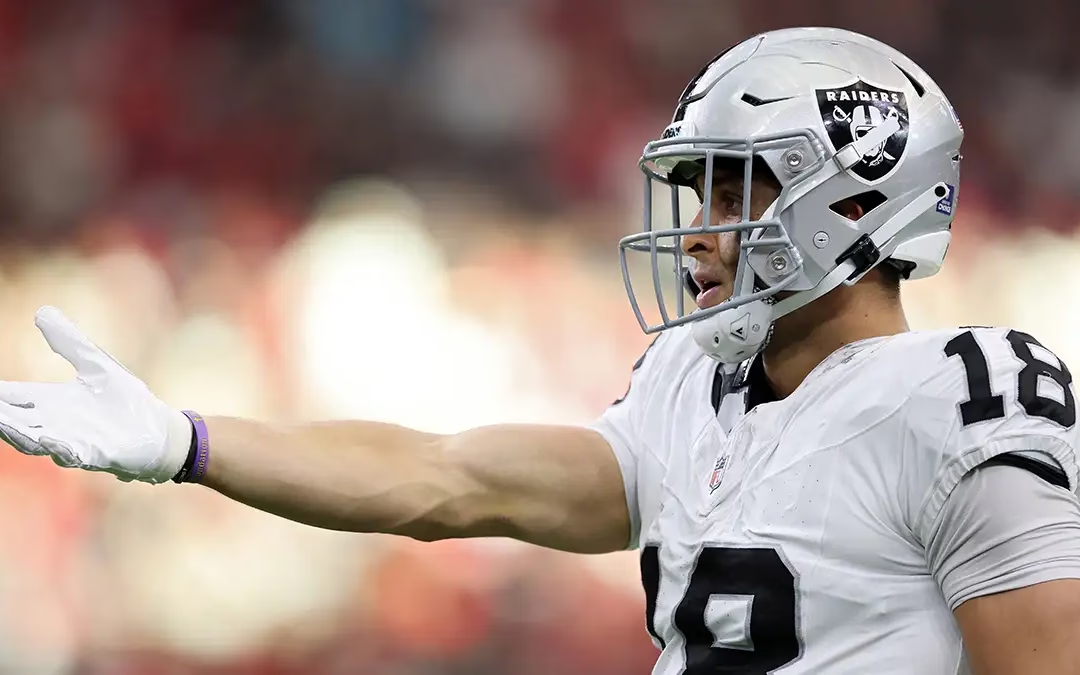

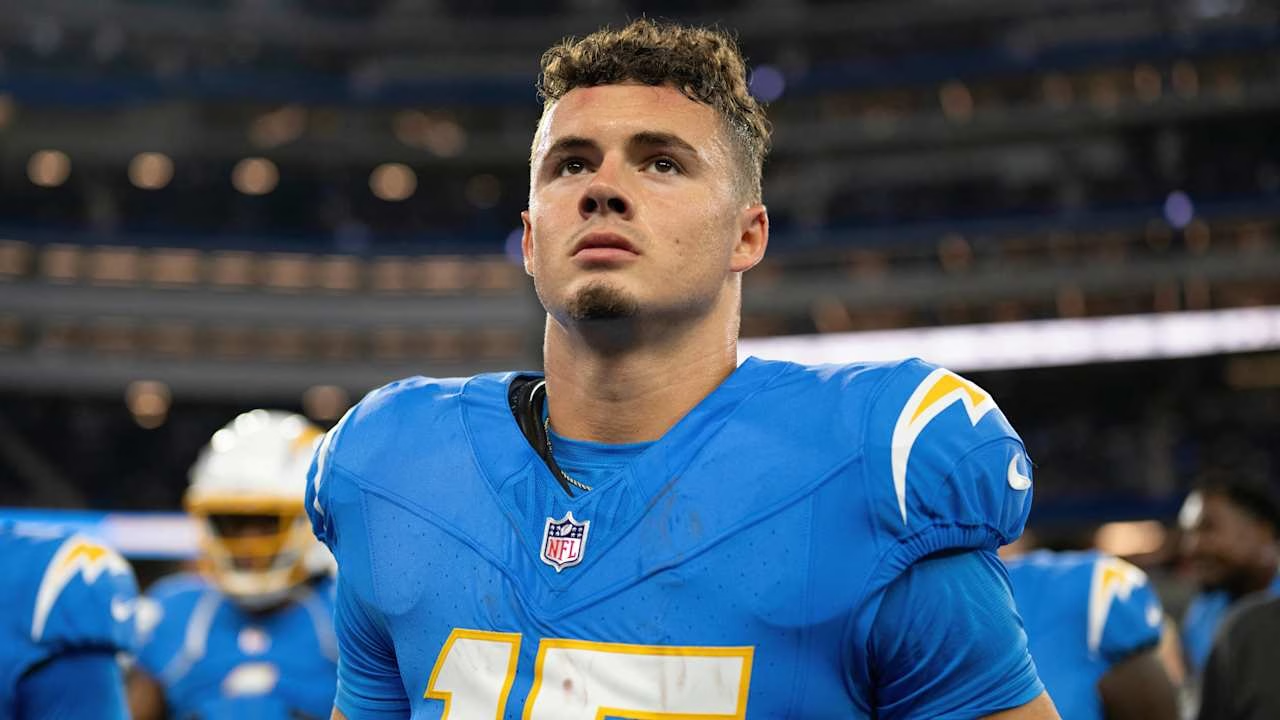
Ladd McConkey frustrated a lot of fantasy managers in 2025.
That is exactly why he is interesting again.
Fantasy managers are usually quick to forgive players who miss time with obvious injuries. They are much less forgiving when a player simply disappoints. McConkey’s second season was not a disaster, but it was frustrating enough to knock him out of the exciting breakout conversation and push him back into the low-end WR2 range.
That creates the buying window.
The case for McConkey in 2026 is not built on blind optimism. It is built on a simple question:
What if the 2025 Chargers offense was the problem, not Ladd McConkey?
Keenan Allen is no longer blocking the top target role. The offense has a new coordinator. Justin Herbert is still one of the best quarterbacks in football. And McConkey has already shown he can produce at a high level when the passing game runs through him.
At his current price, that makes him one of the more appealing wide receiver values in 2026 fantasy football drafts.
The Rookie-Year Breakout Was Real
It is easy to forget how impressive McConkey was as a rookie.
The Chargers selected him with the 34th pick in the 2024 NFL Draft, and he immediately looked like one of the better young wide receivers in football. He finished his rookie season with:
- 82 receptions
- 1,149 receiving yards
- 7 touchdowns
- 112 targets
He led the Chargers in targets, finishing ahead of Quentin Johnston, who had 91.
That was not empty production.
McConkey looked like a receiver who could separate quickly, win in the short and intermediate areas, earn volume, and create after the catch. He was not just a gadget player or a slot-only compiler. He looked like a real target earner attached to an elite quarterback.
Then he raised expectations even higher in the playoffs.
Against a tough Texans defense, McConkey caught nine of 14 targets for 197 yards and a touchdown. That performance made it easy to imagine him becoming Justin Herbert’s long-term WR1.
That is why expectations got so aggressive heading into 2025.
And that is also why the disappointment felt so loud.
What Went Wrong in 2025?
McConkey’s sophomore season was not awful.
It was just not what fantasy managers wanted.
He played 16 games and finished with:
- 66 receptions
- 789 receiving yards
- 6 touchdowns
- 106 targets
The targets did not collapse. They only dropped from 112 to 106.
But the quality of his role changed.
As a rookie, McConkey was targeted on 23.3% of his routes and averaged 2.39 yards per route run. In 2025, his target rate fell to 19.2%, and his yards per route run dropped to 1.43.
That is a real decline.
The biggest reason was the return of Keenan Allen. Even though Allen was no longer in his prime, he still commanded volume and led the Chargers with 122 targets. Johnston also remained involved with 84 targets, leaving McConkey in a more crowded passing game than fantasy managers wanted.
That matters because McConkey’s fantasy value is tied to volume.
He is not a pure deep threat who can survive on three targets and one splash play. He is at his best when the offense creates space, lets him win quickly, and gives him enough targets to build weekly consistency.
In 2025, the target environment was messier.
In 2026, it looks much cleaner.
Why the 2026 Setup Looks Better
The biggest change is simple:
Keenan Allen is not back.
That puts McConkey in position to lead the Chargers in targets again.
Johnston is still there as the likely WR2, and the Chargers have depth behind him, but this no longer looks like an offense where McConkey has to fight Allen for the first read every week.
If McConkey is the best separator on the roster and Herbert’s most reliable receiver, the target share can climb quickly.
The other major change is Mike McDaniel.
McDaniel’s time in Miami ended poorly from a head-coaching perspective, but his reputation as an offensive designer still matters. His best offenses created space, manufactured efficient touches, and put explosive receivers in position to attack after the catch.
That is why McConkey fits.
He is not Tyreek Hill.
He does not need to be.
The point is that McDaniel has consistently shown a willingness to feature receivers who win with timing, motion, leverage, speed, and yards-after-catch ability. McConkey fits that type of usage extremely well.
In Miami, Tyreek Hill and Jaylen Waddle were heavily featured when the offense was functioning. In San Francisco, Deebo Samuel turned 121 targets into 1,405 yards during McDaniel’s 2021 season as offensive coordinator.
Now McDaniel gets Justin Herbert.
That is the exciting part.
Herbert gives this offense a quarterback ceiling that can support high-end fantasy production if the passing game becomes more creative and efficient. If the Chargers take a step forward through the air, McConkey could be the biggest beneficiary.
The Target Ceiling Is Higher Than the Price Suggests
The biggest reason McConkey looks like a bargain is that his current draft cost may not reflect his realistic target ceiling.
If Allen is gone and McConkey becomes Herbert’s top receiver, 120 targets should be well within reach.
A push toward 130 targets is not unrealistic if the Chargers’ passing game improves and McConkey becomes the primary separator in the offense.
That is where the price starts to look interesting.
McConkey is currently being drafted around pick 42 as the WR20 in multi-site ADP. That puts him in the same range as players like Tetairoa McMillan, Emeka Egbuka, and Jaylen Waddle.
That is not a bad range.
But it may still be too low.
McConkey has already shown a WR1 ceiling. He finished as WR11 as a rookie, then saw his price drop after one frustrating season in a crowded target environment.
Now the target competition is lighter, the offensive coordinator change is exciting, and Herbert is still attached to him.
That is the type of profile fantasy managers should be chasing.
The market is pricing McConkey like a low-end WR2.
The setup gives him a path to finish much higher than that.
McConkey’s Profile Is Cleaner Than Some Receivers in His Range
The wide receivers going around McConkey all have appeal.
But his profile may be cleaner than the market is giving him credit for.
Tetairoa McMillan is exciting, but his quarterback situation with Bryce Young is much less attractive than McConkey’s setup with Herbert.
Emeka Egbuka has major dynasty appeal and a strong long-term ceiling, but his target competition and weekly role still need to play out.
Jaylen Waddle is talented and explosive, but his fantasy value has often depended on how concentrated and healthy the Miami offense can be.
McConkey may not be the flashiest name in that group.
But he checks a lot of boxes:
- strong quarterback play;
- proven target-earning ability;
- prior fantasy production;
- a clearer path to leading his team in targets;
- offensive-design upside;
- a current price that does not require a ceiling outcome.
That is what makes him appealing.
You are not drafting McConkey because you hope he becomes good.
You are drafting him because he has already been good, his 2025 decline is explainable, and the 2026 environment looks better.
That is a very different bet.
The Risk Is Still There
McConkey is not risk-free.
If Allen somehow returns to the Chargers, the target projection gets murkier. If Johnston takes a major step forward, McConkey’s ceiling could be lower than expected. If McDaniel’s offense takes time to settle in, the efficiency may not immediately bounce back.
There is also a fair question about McConkey’s ultimate ceiling.
Is he a true alpha receiver?
Or is he more of a highly efficient target earner who needs the right offensive structure to deliver WR1 production?
That distinction matters.
But fantasy football is not about finding perfect players.
It is about finding players whose price does not fully reflect their upside.
At WR20, McConkey does not need everything to go right to be useful. He only needs the target environment to shift back in his favor and the Chargers’ passing game to become more efficient than it was last season.
Those are reasonable bets.
And if both happen, his current ADP may look too low very quickly.
The Final Verdict
Ladd McConkey is the kind of fantasy football value that exists because last year was disappointing enough to reset expectations.
His rookie season showed the upside:
82 catches, 1,149 yards, seven touchdowns, and a playoff explosion that made him look like Justin Herbert’s long-term WR1.
His sophomore season created the discount:
lower efficiency, fewer catches, a crowded target tree, and Keenan Allen soaking up the team lead in targets.
Now the situation has changed again.
Allen is not back. McConkey has a clearer path to leading the Chargers in targets. Mike McDaniel brings a more creative offensive structure. Herbert remains a major quarterback advantage. And McConkey’s current ADP still treats him like a low-end WR2 rather than a player with a real path back to WR1 production.
That is the opportunity.
You do not need to draft McConkey like he is guaranteed to smash.
You just need to recognize that the market may be overcorrecting from one disappointing season.
If the Chargers’ offense rebounds and McConkey pushes toward 120-plus targets, he will not be priced like this for long.
That is why Ladd McConkey is one of the better fantasy football values in 2026 drafts.