
Late-round fantasy football picks should not be wasted on players who only feel safe.
By the end of your draft, you are not trying to build the most comfortable bench. You are trying to find players who can become more valuable quickly.
That usually means chasing one of a few things: a young player climbing a depth chart, a backup running back tied to a fragile starter, a cheap receiver with a realistic path to targets, a tight end whose route role may be better than the box score suggests, or a former fantasy producer whose injury discount has gone too far.
That is what makes bench stashes valuable.
They do not need to be weekly starters in September. They need to be players you can look back on in October and say, “The role was starting to show before everyone else noticed.”
For 2026 fantasy football drafts, these eight players are worth knowing:
Ja’Kobi Lane.
Cyrus Allen.
Tank Dell.
Kaelon Black.
Greg Dulcich.
Caleb Douglas.
Jack Bech.
Jonah Coleman.
Not all eight belong in the same tier. Some are true late-round upside targets. Some are deeper-league bench stashes. One or two are closer to watch-list names than must-draft players.
But each one has a specific reason to be on the radar.
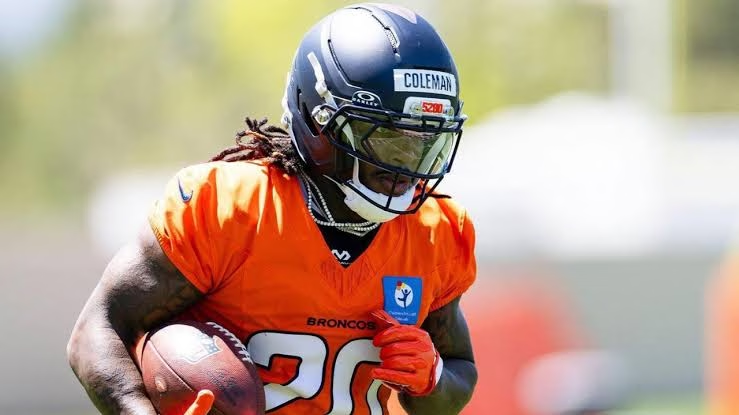
Jonah Coleman, RB, Denver Broncos
Jonah Coleman is one of the best bench stashes in this group because his path is easy to understand.
He needs the Denver backfield to open.
That is realistic enough to matter.
Coleman is not walking into a guaranteed Week 1 role. The Broncos still have J.K. Dobbins and RJ Harvey, so this is not an empty depth chart. But Dobbins’ injury history is difficult to ignore, and Harvey did not fully lock down the job when given chances last season.
That creates a real opening.
Coleman also brings a fantasy-friendly profile. He scored 25 rushing touchdowns over his final two college seasons, giving him a plausible path to short-yardage and goal-line work even if he does not immediately become the full-time back.
That is what makes him interesting.
He does not need to beat out everyone on Day 1 to matter. He could earn goal-line work. He could become the next man up if Dobbins misses time. He could push Harvey if Denver wants a more physical option. He could become a usable flex if the backfield thins out.
That is exactly the kind of late-round running back profile worth chasing.
Coleman is not a safe weekly starter. He is a bench bet on role expansion, touchdown access, and running back fragility.
If Denver’s backfield stays healthy and settled, he may sit on your bench or hit waivers. But if the role shifts, Coleman has the kind of profile that can become valuable quickly.
That is what you want from a bench stash.
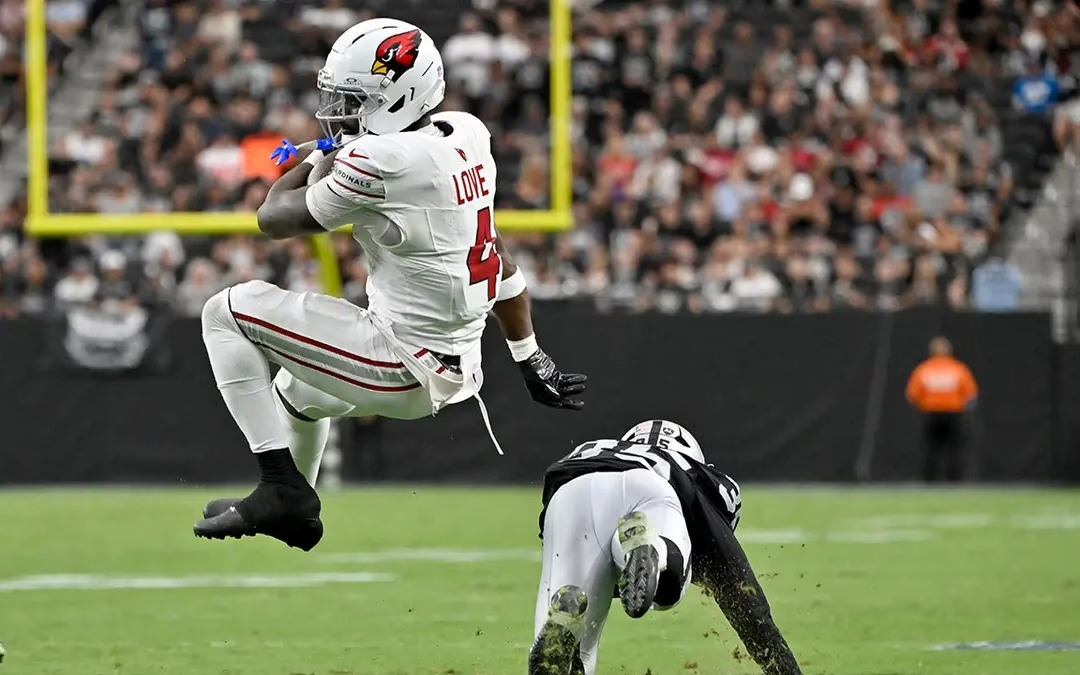
Kaelon Black, RB, San Francisco 49ers
Kaelon Black is the type of running back stash fantasy managers should understand before draft day.
He may not have much standalone value if Christian McCaffrey is healthy and handling a major workload.
But the 49ers’ backup running back role matters.
San Francisco’s offense has been one of the most fantasy-relevant running back environments in football, and any back with a clear path to touches behind McCaffrey deserves attention. McCaffrey is still elite, but his workload and injury history make the No. 2 job valuable.
Black appears to be pushing ahead in that race.
The 49ers added him with meaningful draft capital, and his preseason usage suggested he may have moved ahead of Jordan James. In San Francisco’s third preseason game, Black played the first three drives before James saw offensive work.
That is the kind of signal that matters.
Not the box score.
The role.
Black is still cheap enough that you are not spending a premium pick. You are buying access to one of the most valuable contingency roles in fantasy football.
If McCaffrey stays healthy all year, Black may be a bench hold who never cracks your lineup. But if the depth chart breaks his way, he could become one of the fastest risers in fantasy.
That is late-round running back upside.
Ja’Kobi Lane, WR, Baltimore Ravens
Ja’Kobi Lane is one of the cleaner late-round wide receiver stashes because the role he could win actually matters.
Baltimore already has Zay Flowers and Rashod Bateman, but the Ravens did not bring back several depth receivers, leaving the No. 3 wide receiver role open. Lane is part of that competition, and his skill set gives him a specific path to relevance.
The appeal is not just that he is a rookie with buzz.
It is that he gives Baltimore something different.
Lane is 6-foot-4 and roughly 200 pounds, giving Lamar Jackson a bigger red-zone target in an offense that already has speed and separation elsewhere. A receiver does not need 120 targets to matter if he can become a high-leverage touchdown option.
That is especially true in deeper leagues and best ball formats.
If Lane wins a meaningful role and becomes a touchdown threat, he can produce spike weeks even in a lower-volume passing offense.
That is also the main risk.
Baltimore may not throw enough to support multiple reliable fantasy receivers. Zay Flowers, Mark Andrews, and Rashod Bateman still matter. Lane could win the WR3 job and still be hard to trust in managed leagues.
But as a late-round stash, he makes sense.
He is not just a random rookie.
He has a role he can win.
Cyrus Allen, WR, Kansas City Chiefs
Cyrus Allen is the lottery ticket.
When you are drafting late, that is exactly what you should be looking for.
The appeal is obvious. He is a rookie receiver tied to Patrick Mahomes and Andy Reid, and Kansas City’s receiver room is not settled enough to ignore a cheap upside bet.
Allen was not a premium draft pick, so the draft capital does not guarantee anything. But the camp buzz and depth-chart uncertainty make him interesting.
You are not paying for a proven role.
You are paying for the chance that Kansas City’s receiver room is less stable than the market thinks.
Rashee Rice has health and availability questions. Xavier Worthy has big-play ability, but he may not be a traditional volume receiver. If Allen earns trust over the middle of the field and starts getting designed looks, his price can change quickly.
That is the stash case.
The risk is that he opens the season in a limited role and never becomes more than a depth piece. That is possible. Rookie receivers can flash in camp and still struggle to earn consistent snaps once the season starts.
So do not draft Allen expecting immediate WR3 production.
Draft him because the path is there.
A cheap rookie receiver attached to Mahomes does not need everything to go right before fantasy managers start paying attention.
If Allen earns early targets and comes out of the first month with a growing role, he will not stay free for long.
Tank Dell, WR, Houston Texans
Tank Dell is not a normal sleeper.
He is an injury-discounted former producer whose market has fallen far enough to make the upside worth revisiting.
The risk is obvious. Dell suffered a major knee injury, and Houston has been easing him back. He may not be ready to play a full role immediately, and even when he does return, he may need time to regain explosiveness.
That is why he is cheap.
But the Texans’ receiver situation has also shifted in a way that keeps Dell relevant. Houston lost key receiver depth, and the path to snaps is not as crowded as it looked earlier in the offseason.
That does not make this a clean setup.
It makes it a path.
Dell does not need to be the same player in Week 1 for this pick to work. He needs to be a bench stash who can regain a role as the season progresses.
The mistake would be drafting him like he is locked into a full-time job right away. He may not be. He could rotate. He could be eased in. The injury was serious enough that patience is required.
But the other mistake is ignoring him entirely because of the injury.
If Dell gets healthy, he still has a path to meaningful snaps in a C.J. Stroud offense. That combination is enough to make him draftable late.
Dell is not a safe pick.
He is a bet that the injury discount is bigger than the actual rest-of-season risk.
Greg Dulcich, TE, Miami Dolphins
Greg Dulcich is a tight end sleeper, which means the bar is different.
At tight end, you are not always looking for the next superstar. Sometimes you are looking for a player whose role gives him enough routes to become a usable weekly option.
Dulcich has that kind of path.
Miami’s tight end room changed this offseason, and Dulcich has a chance to become the primary passing-down option. That distinction matters because fantasy managers should care more about routes than raw snaps.
A tight end who plays passing downs is more valuable than a tight end who piles up run-blocking snaps.
That is the key to Dulcich.
His preseason usage may look messy if you only glance at the total snap count, but the role is more interesting if he is the tight end used in passing personnel. In fantasy, routes are where the points come from.
There are still risks.
Miami’s receiver hierarchy may limit how much target volume is available. The Dolphins could still rotate tight ends. Dulcich has not exactly been a model of bankable fantasy production.
So this is not a slam dunk.
But late tight end darts do not need to be perfect. They need a path to routes, targets, and occasional spike weeks.
Dulcich has that.
If Miami uses him as its primary receiving tight end, he can beat his price quickly.
Caleb Douglas, WR, Miami Dolphins
Caleb Douglas is one of the more interesting deep receiver stashes because his preseason role has been louder than his draft cost.
Miami’s wide receiver room changed dramatically this offseason, leaving a much different target tree than fantasy managers are used to seeing. That created an opening for a younger receiver to push into real playing time.
Douglas appears to be one of the names that matters.
His preseason usage with the starters was encouraging. He worked heavily with Miami’s first-team offense and appeared to be treated as one of the top receivers in the rotation.
That is a real role signal.
It does not make him a must-draft player in every league, but it does make him worth tracking closely.
There is still competition. Miami has multiple receivers fighting for snaps, and Douglas still needs to prove he can hold the role once the games count. If he does not clearly separate, this could become a frustrating rotation.
That is the risk.
The price is the reason to care.
Douglas is still cheap enough that the cost is minimal. If he opens the season as one of Miami’s top two receivers, the market will have to adjust.
That is what makes him a strong deep stash.
You are not paying for certainty.
You are paying for the chance that the preseason usage was telling us something before the rest of the market reacts.
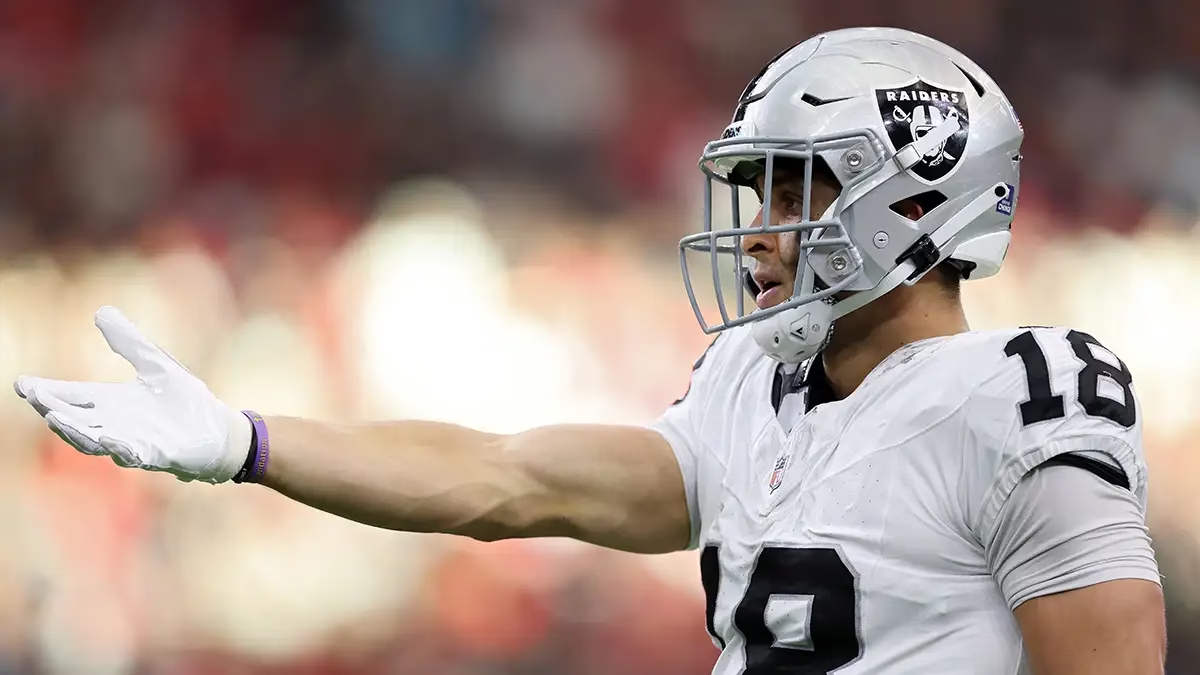
Jack Bech, WR, Las Vegas Raiders
Jack Bech is the one player on this list who needs the most caution.
He is draftable in very deep leagues, but the current role signals are not especially strong.
That matters.
The Raiders’ receiver room has been shifting, and Bech appears to be working mostly as a slot option. That can be useful, but only if the role comes with enough routes and targets to matter.
Right now, that is not guaranteed.
Bech has been involved, but the preseason usage did not clearly show that he would be a full-time player or the next man up if one of the starters missed time. That makes the path narrower than some of the other names on this list.
Cheap does not automatically mean good.
A late-round pick still needs a path to fantasy relevance.
For Bech, that path likely requires more three-receiver sets than expected, a larger slot role, or an injury ahead of him. Without one of those things, he may be more interesting as a watch-list name than a standard redraft stash.
That does not mean he is useless.
It means you need to understand what you are buying.
Bech is not a clear breakout profile right now. He is a cheap receiver in a reshuffled offense who needs the depth chart to break his way.
That is fine as a last-round dart in deep formats.
It is not a player to force.
How to Rank These Bench Stashes
Not every stash fits every roster.
If you want the best overall upside, Jonah Coleman, Kaelon Black, and Ja’Kobi Lane are the top names.
Coleman has the best combination of talent, role upside, and potential standalone value. Black has one of the clearest handcuff paths if he has truly won the 49ers’ No. 2 job. Lane has the best touchdown-based wide receiver case.
If you want wide receiver upside, Cyrus Allen, Caleb Douglas, and Tank Dell are the preferred targets.
Allen has the highest-ceiling landing spot because he is attached to Mahomes. Douglas has the strongest immediate role signal. Dell has the best past production profile, but his injury recovery makes him harder to project.
If you want a late tight end dart, Greg Dulcich is the name.
His passing-down role and prior efficiency make him a useful cheap bet at a thin position.
If you are in a very deep league, Jack Bech is worth monitoring.
He is cheap, but the current usage makes him more of a watch-list player than a priority target in typical redraft leagues.
The StatChasers Bench Stash Test
Before drafting a late-round stash, ask three questions.
First, what changes his value quickly?
For Coleman and Black, it is running back usage. For Lane and Allen, it is touchdown or target growth. For Dulcich, it is routes. For Douglas, it is staying in the top two of the Miami receiver room. For Dell, it is health. For Bech, it is a larger role than the preseason usage currently suggests.
Second, is the price still cheap enough?
The later the pick, the more risk you can accept. That is why Allen, Douglas, Dell, Dulcich, Bech, and Black are easier to justify late. Coleman costs more, but the upside is more direct.
Third, can he actually hit your lineup?
A bench stash should not just be interesting. He should have a real path to starting weeks. Touchdowns, injuries, target growth, or route participation need to create a usable fantasy outcome.
If the path is only theoretical, keep him on the watch list instead.
The Final Verdict
Late-round fantasy football is not about drafting the safest names left.
It is about drafting players whose roles can change fast.
Ja’Kobi Lane has red-zone upside in Baltimore. Cyrus Allen has a path to surprising relevance in Kansas City. Tank Dell is an injury-discounted receiver in a Texans offense with opportunity. Kaelon Black may be the 49ers handcuff worth drafting. Greg Dulcich has a passing-down tight end role that could matter. Caleb Douglas has flashed real starter usage in Miami. Jack Bech is a deep-league stash, but the role needs to improve. Jonah Coleman has the most direct path to running back value if Denver’s backfield shifts.
That is the bench stash game.
You do not need all of them to hit.
You just need to draft the ones whose price, path, and upside line up.
Because the best late-round picks are rarely the players who look useful today.
They are the players who become obvious tomorrow.