Week 1 is always chaos.
Some players enter the weekend questionable. Some get removed from the injury report and immediately become lineup decisions. Some make it through warmups and still look limited. And some injuries hit during the games and completely change the fantasy football landscape before managers even get to Monday morning waivers.
That is why injury reports are not just about who is active and who is inactive.
They are about role changes. They are about waiver-wire windows. They are about whether a player should be started, stashed, sold, or replaced.
A player being “active” does not always mean he is safe. A player being “out” does not always mean the backup is an automatic smash. And a player being removed from the injury report does not always mean the injury no longer matters.
Week 1 gave fantasy managers a little bit of everything: pregame uncertainty, players returning from camp injuries, stars missing time, and several new injuries that could shape the next month of the season.
Here are the injury situations that matter most for fantasy football.
Week 1 Fantasy Football Injury Tracker
| Player | Fantasy Impact | Injury | Estimated Return |
|---|---|---|---|
| Brock Bowers | High | Knee / partial meniscectomy | Week 3-6 |
| A.J. Brown | High | High ankle sprain | Week 7 |
| Sam Darnold | Medium | Glute tendon | Week 5-7 |
| Kyler Murray | Medium | Concussion | Week 3-4 |
| Zay Flowers | High | Hamstring | TBD |
| Ladd McConkey | High | Chest / ribs | TBD |
| Omar Cooper Jr. | Medium | High ankle sprain | Week 5-6 |
| Chigoziem Okonkwo | Low | Hamstring | TBD |
| Dylan Sampson | Low | Knee | TBD |
| Ja’Kobi Lane | Medium | Wrist fracture | Week 7-11 |
| Zach Charbonnet | Medium | ACL | Week 5-11 |
| Tank Dell | Medium | Multi-ligament knee injury | Week 10-14 |
| Jordyn Tyson | Medium | Hamstring | Week 7-9 |
| Jonathon Brooks | Low | Groin | Cleared Week 1 |
| Rome Odunze | Low | Calf | Cleared Week 1 |
| Emeka Egbuka | Low | Toe | Cleared Week 1 |
| Ja’Marr Chase | Low | Knee | Cleared Week 1 |
| Tee Higgins | Low | Foot / heel | Cleared Week 1 |
| Alec Pierce | Low | Ankle | Cleared Week 1 |
| Breece Hall | Low | Groin | Cleared Week 1 |
| Kenyon Sadiq | Low | Groin | Cleared Week 1 |
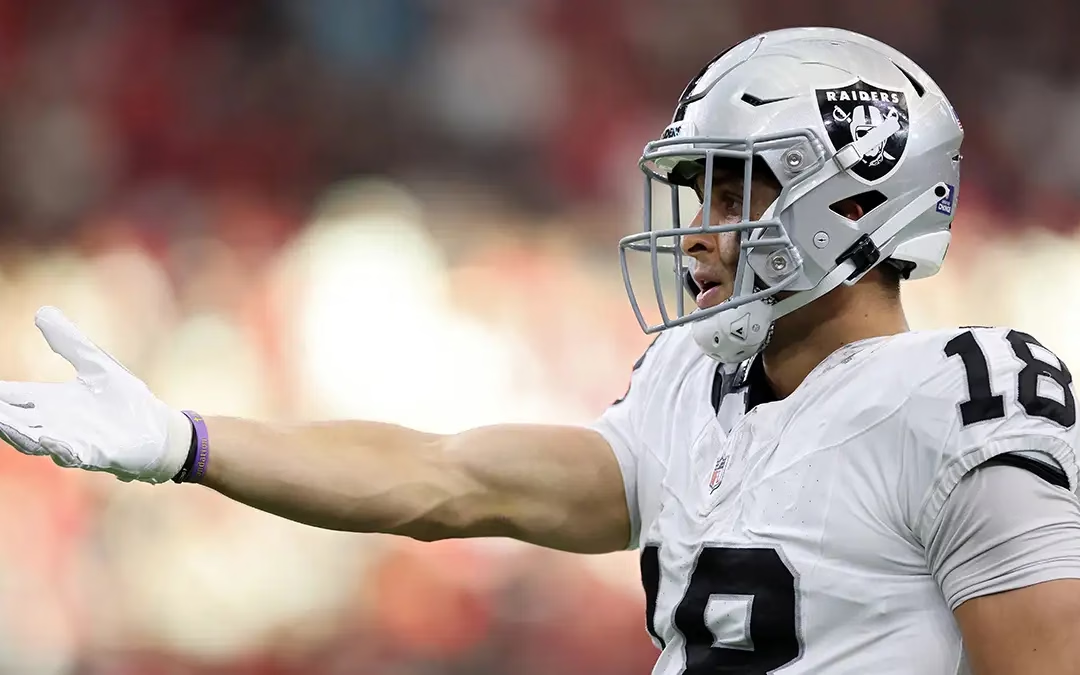
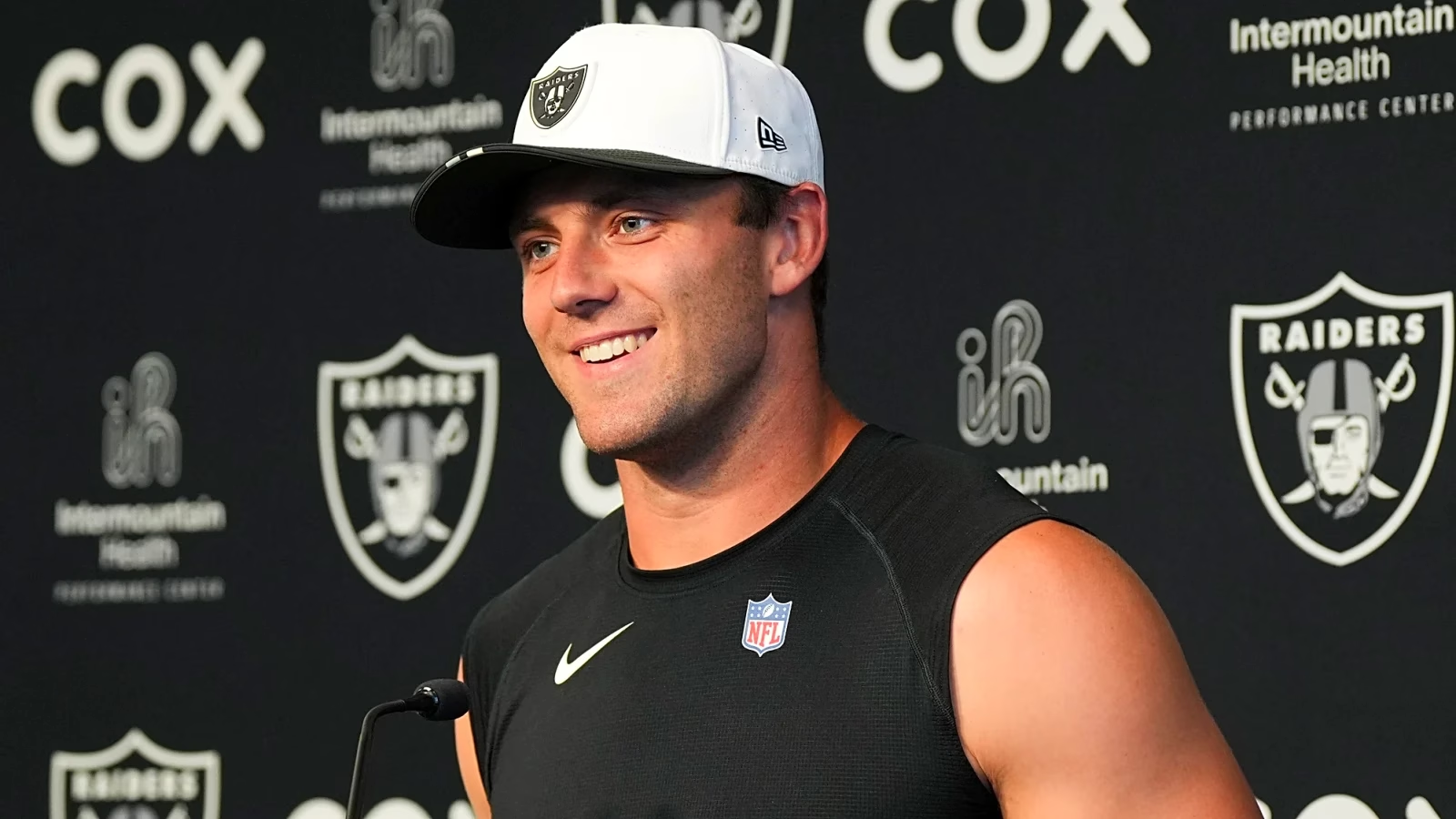
Brock Bowers, TE, Raiders — Knee
Brock Bowers was one of the biggest injury shocks of Week 1.
He underwent a partial meniscectomy, which means part of the meniscus was removed from the knee. The short-term timeline being floated is aggressive, but the range is wide enough that fantasy managers need to be careful.
The current projected return window is Week 3-6, but the risk is not just about when Bowers returns. It is about what he looks like when he does.
Tight end is already a fragile fantasy position. Bowers is talented enough to remain a difference-maker when healthy, but knee issues can affect explosiveness, route tempo, change of direction, and post-catch ability.
This is not a “drop him” situation.
It is not even close.
But if you drafted Bowers as a premium tight end, you now need a real short-term plan. Do not assume a one-week absence. Do not assume he immediately returns to full usage. And do not treat the projected return window like a guarantee.
Fantasy Impact
Bowers managers need to add a usable tight end immediately.
If another manager is panicking in dynasty, this is still a buy-low opportunity on elite talent. But in redraft, the focus is survival. You need points now.
Verdict
Hold Bowers, but prepare for multiple missed games and a possible ramp-up period when he returns.
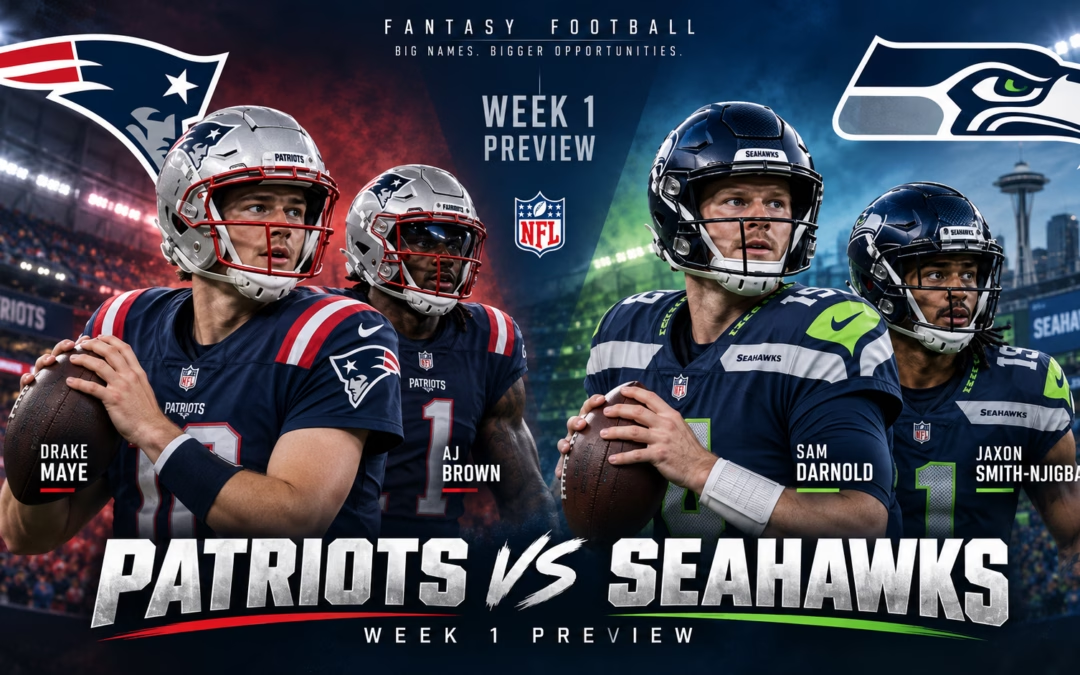
A.J. Brown, WR, Patriots — High Ankle Sprain
A.J. Brown landing on IR is a massive early-season blow.
The injury is a high ankle sprain, and the current projected return is Week 7. That timeline makes sense given the expectation that he could miss several weeks.
High ankle sprains are especially frustrating for wide receivers because the issue is not just pain tolerance. The injury can affect power, push-off, cutting, jumping, and route explosiveness.
That matters for Brown.
His game is built on strength, physicality, body control, and winning through contact. If he comes back before the ankle is fully ready, he could be active without immediately looking like the same player.
For fantasy managers, the immediate question is not whether Brown is droppable.
He is not.
The question is how much of the Patriots offense shifts while he is gone.
Romeo Doubs becomes more important. DeMario Douglas becomes more interesting in PPR formats. Hunter Henry may see more underneath and red-zone usage. And Drake Maye now has to navigate the early part of the season without his biggest offensive addition.
Fantasy Impact
Brown is an IR hold everywhere.
Doubs gets a target bump. Douglas becomes a deeper-league PPR add. Henry becomes more usable as a touchdown-based tight end. Maye remains startable, but his ceiling takes a hit without Brown.
Verdict
Hold Brown, but do not expect full WR1 impact immediately when he returns.
Sam Darnold, QB, Seahawks — Glute Tendon
Sam Darnold avoided a season-ending injury, but the current outlook still matters.
The injury is being described as a glute tendon issue, with a projected return window around Week 5-7. That puts Seattle in a difficult spot early in the season.
This matters beyond Darnold himself.
The Seahawks offense is built around timing, play action, and keeping the structure stable. If Darnold misses several games, that affects Jaxon Smith-Njigba, Cooper Kupp, Rashid Shaheed, AJ Barner, and the entire passing game.
It may also push Seattle toward a more run-heavy identity.
That could mean more volume for Jadarian Price and Emanuel Wilson, especially if the Seahawks want to protect the quarterback situation and avoid putting too much on the passing game.
Fantasy Impact
Darnold is only a hold in Superflex or deeper two-quarterback formats.
JSN remains a start because volume should keep him afloat, but his ceiling becomes shakier. Kupp becomes more PPR-dependent. Shaheed becomes even more boom/bust. Barner becomes harder to trust outside of tight end desperation.
Verdict
Seattle pass catchers are still playable, but expectations need to come down until the quarterback situation stabilizes.
Kyler Murray, QB, Vikings — Concussion
Kyler Murray suffered a concussion in Week 1 and now has to clear protocol before returning.
The current projected return window is Week 3-4, but concussion timelines are difficult because they depend on symptom resolution and progression through each stage of the protocol.
For fantasy managers, this is a major short-term hit.
Murray’s rushing ability changes the Vikings offense. It creates easy fantasy points, extends drives, and opens space for the passing game. Without him, Minnesota’s offense becomes more fragile.
That impacts Justin Jefferson, Jordan Addison, T.J. Hockenson, and the running backs. They are not unusable, but the weekly ceiling changes if the offense becomes less explosive.
Fantasy Impact
Murray managers need a short-term quarterback replacement.
Jefferson remains a must-start. Hockenson remains playable. Addison becomes more matchup-dependent. The running backs could see more volume, but scoring chances may be less stable.
Verdict
Hold Murray, but prepare as if he misses at least one game and possibly more.
Zay Flowers, WR, Ravens — Hamstring
Zay Flowers is one of the most important injury situations to monitor because hamstrings can linger.
He entered Week 1 with prior hamstring concerns and appeared to aggravate the issue. The current return timeline is still unclear, and he is questionable for Week 2.
This is the exact type of injury fantasy managers should not casually brush off.
Wide receivers need acceleration, deceleration, burst, and lateral movement. A hamstring injury can reduce all of that. Even worse, re-injury risk tends to be elevated when players return quickly from muscle strains.
That does not mean Flowers is suddenly a sell.
But it does mean managers need to prepare for volatility.
The Ravens passing game can still function, but Flowers is the receiver who gives the offense its most dynamic short-area and after-catch element. If he misses time or plays limited snaps, Rashod Bateman and the tight ends become more important.
Fantasy Impact
Flowers is a hold, but he needs to be treated as questionable until we get clarity.
Bateman gets a short-term bump if Flowers misses time. Baltimore may also lean more on tight ends and the run game if the receiver room gets thin.
Verdict
Do not panic-sell, but build a backup plan now.
Ladd McConkey, WR, Chargers — Chest
Ladd McConkey exited Week 1 with a chest injury after taking a hard hit.
The exact diagnosis matters a lot here.
If it is a rib contusion, the absence could be short. If it is a rib fracture, the timeline could stretch several weeks. That uncertainty makes McConkey one of the most important names to monitor.
His fantasy value is tied to timing, volume, and working the middle of the field. A chest or rib injury can make it harder to absorb contact, extend for passes, and operate comfortably in traffic.
That is not ideal for a receiver whose role often requires him to win in condensed areas.
Fantasy Impact
McConkey managers should not drop him or panic, but they should prepare for missed time or limited usage.
If he misses time, Quentin Johnston and the Chargers secondary receivers get more opportunity. Justin Herbert’s weekly ceiling could take a hit if McConkey is limited.
Verdict
Hold, monitor the diagnosis, and do not assume he is safe until the injury is clarified.
Omar Cooper Jr., WR, Jets — High Ankle Sprain
Omar Cooper Jr. suffered a high ankle sprain and is currently projected to return around Week 5-6.
That is a tough break for a young receiver trying to carve out a role early in the season.
High ankle sprains are difficult for wide receivers because the recovery is not only about returning to the field. It is about regaining burst, push-off, and confidence changing direction.
For fantasy managers, this likely pushes Cooper off the immediate redraft radar.
The Jets already have Garrett Wilson, Adonai Mitchell, and Kenyon Sadiq involved in the passing-game picture. Missing early-season time makes it difficult for Cooper to earn enough volume to matter quickly.
Fantasy Impact
Cooper is a dynasty stash and deep-league hold.
In normal redraft leagues, he can be dropped unless you have deep benches or IR space.
Verdict
Hold in dynasty. Move on in shallow redraft if you need the roster spot.
Chigoziem Okonkwo, TE, Commanders — Hamstring
Chigoziem Okonkwo left Week 1 with a hamstring injury, and the timeline remains unclear.
This is frustrating because tight end is already thin. Okonkwo has always had the athletic profile to matter, but consistency has been the issue.
A hamstring injury makes that even harder.
If he misses time, the Titans may need to redistribute short-area targets. That could help the wide receivers or running backs more than it creates a direct tight end replacement.
Fantasy Impact
Okonkwo is not a must-hold in shallow leagues if you need immediate tight end production.
In deeper formats, he can be held until we get a better timeline.
Verdict
Monitor, but be willing to stream tight end instead of waiting.
Dylan Sampson, RB, Browns — Knee
Dylan Sampson was seen on crutches and wearing a brace after Week 1, though he was reportedly able to jog on the sideline before leaving.
That creates uncertainty.
The fact that he could jog is a better sign than an immediate cart-off scenario, but crutches and a brace after the game still require caution.
Until testing confirms the severity, fantasy managers should not make hard conclusions.
The Browns backfield is not loaded with obvious fantasy value, but any missed time from Sampson can still affect depth, passing-down usage, and waiver options in deeper leagues.
Fantasy Impact
Sampson is a hold in deeper leagues until the diagnosis is confirmed.
In shallow formats, he is not a must-hold unless your bench is deep.
Verdict
Wait for testing before reacting.
Ja’Kobi Lane, WR, Ravens — Wrist
Ja’Kobi Lane fractured his wrist and is expected to miss several weeks, with a possible return window around Week 7-11.
That is brutal timing.
Lane was one of the more interesting late-round rookie receivers because he had a path to playing time in Baltimore. His size and touchdown upside made him a fun stash, especially in deeper leagues and best ball formats.
Now the short-term redraft appeal takes a major hit.
Wrist injuries are especially tricky for receivers because catching, securing the ball, hand fighting, blocking, and contested-catch situations all require strength and confidence through the hands and wrists.
Lane can return this season, but he may need time to regain full comfort.
Fantasy Impact
Lane is an IR stash in dynasty and very deep redraft leagues.
In standard redraft, he can be dropped if you need active roster help. Bateman and the Ravens tight ends become more important if Flowers also misses time.
Verdict
Hold in dynasty. Drop in most shallow redraft leagues.
The StatChasers Injury Rules for Fantasy Managers
1. “Active” does not always mean healthy.
Players can suit up and still be limited.
Wide receivers with soft-tissue injuries and running backs returning from lower-body issues are especially risky.
2. Practice participation matters.
Full practices late in the week are usually a green light.
Limited practices all week are a warning.
DNPs on Thursday and Friday are a problem.
3. Injury type matters more than injury label.
A “knee” injury can mean anything.
A meniscus procedure, ACL issue, bruise, or sprain all carry different fantasy consequences.
4. Look for the replacement role, not just the backup.
The next man on the depth chart is not always the fantasy winner.
Sometimes the passing-down back benefits. Sometimes the slot receiver benefits. Sometimes the tight end benefits. Sometimes the entire offense just gets worse.
That is why fantasy managers need to think beyond the backup’s name.
They need to think about the role that actually opens.
5. Do not waste IR spots.
Use IR for players with real return value.
Bowers, Brown, Murray, Dell, Charbonnet, Lane, and Tyson all deserve different treatment depending on format, league depth, and bench size.
A shallow redraft league is not the same as dynasty. A four-bench league is not the same as a deep best ball roster. Context matters.
Final Verdict
Week 1 injuries already changed the fantasy football landscape.
Brock Bowers is dealing with a knee issue that could cost him multiple games. A.J. Brown is on IR with a high ankle sprain. Sam Darnold could miss several weeks. Kyler Murray is in concussion protocol. Zay Flowers, Ladd McConkey, Chigoziem Okonkwo, and Dylan Sampson need more clarity.
Ja’Kobi Lane, Tank Dell, Zach Charbonnet, and Jordyn Tyson are longer-term injury situations that affect both redraft and dynasty decisions.
Meanwhile, several pregame injuries created important Week 1 start/sit decisions.
Jonathon Brooks was cleared but still needed workload caution. Rome Odunze was playable if active, but not risk-free. Emeka Egbuka was a strong start after full practices. Breece Hall was good to go. Alvin Kamara was playable, but risky. And Atlanta’s quarterback injuries put more pressure on Bijan Robinson.
That is the injury report game.
It is not just about who is playing.
It is about how healthy they are, what role they can handle, and who benefits if they are limited.
The managers who win early-season waiver wires are usually the ones who react before the box score makes everything obvious.
Week 1 already gave us the clues.
Now it is time to act on them.